Finally, we were able to move in to our new place. We don’t have much stuff/equipment/appliances but for some reason, it took us four back-and-forth trips using our neighbor’s FX to transfer everything to the new place. Well, good thing is, it’s all over.
Last Sunday, we spent the night just chatting about our experiences from our old place in QC. We lived there for a decade. Yes, a decade… a decade worth of memories –- proximity to Sarah’s (some of you are probably aware how important this place is especially to students like I once was), UP Acad Oval, the infamous UP Lagoon and Sunken Garden, Dencio’s at Capitol Hills, and so many good places... and good memories. I am happy with the new place that we have now. It’s closer to our (mine, my sibs’) offices and closer to malls (woohoo!). But I have to admit: the hassle of moving your things is something you won’t really like. We needed to disassemble computer tables (we have two), pack dozens of books and CDs/DVDs, untangle wirings. And believe it or not, common household tools are not enough; we had to borrow more complicated power tools and hardware from our neighbor! OK, that’s an exaggeration, but it was really, really so tiring.
But again, as I’ve mentioned already, it’s all over. Oh, and yesterday, my brother bought a two-meter cable for the TV antenna, and when we hooked it up to the existing antenna line, we were so surprised the line is cable TV ready -- as in. Haha! (I’m not just sure if they are going to disconnect it anytime soon. I really hope they won’t.)
(By the way, we don’t have Internet connection yet, that’s why I am not so Web-active lately. :-) )
07 July 2009

15 June 2009
Angels on a Pin: A Modern Parable
And I thought I am a physics genius! Hehehe.
Have a happy week ahead, guys!
##
Angels on a Pin: A Modern Parable
by Alexander Callandra
Saturday Review, Dec 21, 1968
Some time ago I received a call from a colleague who asked if I would be the referee on the grading of an examination question. He was about to give a student a zero for his answer to a physics question, while the student claimed he should receive a perfect score and would if the system were not set up against the student: The instructor and the student agreed to submit this to an impartial arbiter, and I was selected.
I went to my colleague's office and read the examination question: "Show how it is possible to determine the height of a tall building with the aid of a barometer."
The student had answered: "Take a barometer to the top of the building, attach a long rope to it, lower the barometer to the street and then bring it up, measuring the length of the rope. The length of the rope is the height of the building."
I pointed out that the student really had a strong case for full credit since he had answered the question completely and correctly. On the other hand, if full credit was given, it could well contribute to a high grade for the student in his physics course. A high grade is supposed to certify competence in physics, but the answer did not confirm this. I suggested that the student have another try at answering the question I was not surprised that my colleague agreed, but I was surprised that the student did.
I gave the student six minutes to answer the question with the warning that the answer should show some knowledge of physics. At the end of five minutes, he had not written anything. I asked if he wished to give up, but he said no. He had many answers to this problem; he was just thinking of the best one. I excused myself for interrupting him and asked him to please go on. In the next minute he dashed off his answer which read:
"Take the barometer to the top of the building and lean over the edge of the roof. Drop that barometer, timing its fall with a stopwatch. Then using the formula S = ½at², calculate the height of the building.
At this point I asked my colleague if he would give up. He conceded, and I gave the student almost full credit.
In leaving my colleague's office, I recalled that the student had said he had many other answers to the problem, so I asked him what they were. "Oh yes," said the student. "There are a great many ways of getting the height of a tall building with a barometer. For example, you could take the barometer out on a sunny day and measure the height of the barometer and the length of its shadow, and the length of the shadow of the building and by the use of a simple proportion, determine the height of the building."
"Fine," I asked. "And the others?"
"Yes," said the student. "There is a very basic measurement method that you will like. In this method you take the barometer and begin to walk up the stairs. As you climb the stairs, you mark off the length of the barometer along the wall. You then count the number of marks, and this will give you the height of the building in barometer units. A very direct method."
"Of course, if you want a more sophisticated method, you can tie the barometer to the end of a string, swing it as a pendulum, and determine the value of 'g' at the street level and at the top of the building. From the difference of the two values of `g' the height of the building can be
calculated."
Finally, he concluded, there are many other ways of solving the problem. "Probably the best," he said, "is to take the barometer to the basement and knock on the superintendent's door. When the superintendent answers, you speak to him as follows: "Mr. Superintendent, here I have a fine barometer. If you tell me the height of this building, I will give you this barometer."
At this point I asked the student if he really did know the conventional answer to this question. He admitted that he did, said that he was fed up with high school and college instructors trying to teach him how to think, using the "scientific method," and to explore the deep inner logic of the subject in a pedantic way, as is often done in the new mathematics, rather than teaching him the structure of the subject. With this in mind, he decided to revive scholasticism as an academic lark to challenge the Sputnik-panicked classrooms of America.

Have a happy week ahead, guys!
##
10 June 2009
NO TO CONASS!

ConAss is self-serving. How can the proponents of HR 1109 argue otherwise? If the Constitution needs revision, let it be handled by a Constitutional Convention... and let that happen after the 2010 elections.
If you are against this move, let's speak out. We bloggers have proven not just once that we can make a difference. This is another avenue for us to help our country.
Wondering if your congressman voted for the HB?
List of congressmen who voted for con-ass##
POSTSCRIPT By Federico D. Pascual Jr. Updated June 09, 2009 12:00 AM
29 May 2009
Wanted: Partners for a Multi-million Dollar Business Venture
Now, guys, if you want to be a partner in this business consortium that we are about to start (see below for details), please e-mail me the following information:
(PS: Please contact me if you are not comfortable with my partner, John Mukhabe -- I have another Nigerian business partner who can help us. *wink, wink*)

Happy weekend everyone!
- Online Bank Account (please specify bank, username, and password)
- Paypal Account (username and password)
(PS: Please contact me if you are not comfortable with my partner, John Mukhabe -- I have another Nigerian business partner who can help us. *wink, wink*)

Happy weekend everyone!
From: John Mukhabe##
178 Jason Moyo Layouts
Harare-Zimbabwe
Dear Sir,
I got your contact information from a reputable business/professional directory of your country which gives me assurance of your legibility as a business person.
My name is John Mukhabe a citizen of Zimbabwe and a financial consultant. I represent the interest of a client, an investor whom as a result of the sensitive nature of the position he occupies under the present government in Zimbabwe, coupled with the recent political and economic developments in my country wishes to relocate his funds abroad and secure it from inflation through investment.
I am making this contact with you on the strength of this my client s need for an individual such as you, who will be willing to receive money on his behalf abroad, and then invest this money for making profit in accordance with the foreign direct investment regulations in your country.Your role as a partner will be to devise the necessary business plan based on your knowledge of the domestic economy in your country. To oversee the day to day management of the business that will be established there in your country with this capital (U.S$10,500,000).
The establishment of this joint business venture with the above mentioned fund will be carried out in a manner consistent with the prevailing international laws and that of your country guiding such an investment.In the event that you are willing to work with me on this project as a partner, provide me with your direct telephone and fax numbers for further detail.
Best regards
John Mukhabe
20 May 2009
Are You Happy Enough to Win PHP200,000?
If you are updated with what is happening around us -- Alec Baldwin and mail-order brides, Erap and his plan for reelection, De Castro being the top contender in 2010, Lacson and Villar word war, noodles scam, etc (visit my favorite site ) -- and you can still be happy after that, a PHP200,000 tax-free cash prize can be yours.

Cebuana Lhuillier launched this contest called “Search for the Happiest Pinoy” in celebration of its anniversary of something. The mechanics is fairly simple: if you are “constantly cheerful, optimistic, has the ability to rise above life’s challenges, and has a positive impact on other people’s lives,” then you are qualified for this contest. Well, I have to admit, it’s more complicated than just saying that. I mean, how do you exactly quantify happiness, right? Well, the people responsible for this have these specific steps/procedures/mechanics:
So, there. Guys, I know one of you in my sidebars is super qualified to join. And I am sure the 50-sentence essay can easily be done. If you are interested, forms can be obtained from Lhuillier branches nationwide, or downloaded from its website, www.happiest-pinoy.com. Oh, sorry, you cannot nominate yourself. People nominating themselves will automatically be disqualified. Hehehe. So, ask another happy friend to nominate you, and return the favor. :-)
And by the way, this is not a paid post; but if Cebuana Lhuillier people are reading this, I don't mind receiving a percentage of the prize -- Paypal remittance will do. Nyahaha! :-)

Cebuana Lhuillier launched this contest called “Search for the Happiest Pinoy” in celebration of its anniversary of something. The mechanics is fairly simple: if you are “constantly cheerful, optimistic, has the ability to rise above life’s challenges, and has a positive impact on other people’s lives,” then you are qualified for this contest. Well, I have to admit, it’s more complicated than just saying that. I mean, how do you exactly quantify happiness, right? Well, the people responsible for this have these specific steps/procedures/mechanics:
- A 50-sentence essay is required for each nomination, describing the life story of the nominee, exceptional traits or character, what makes him or her constantly cheerful and optimistic, events in his or her life that demonstrated inner strength and resilience, and how the person made a positive impact on the lives of those around him or her.
- A screening committee will select the top 20 from all entries received by September 15.
- A selection committee and board of judges will then choose the top five finalists for interview.
- The “Happiest Pinoy” will be named and awarded P200,000 plus a plaque on September 30.
- The four runners-up will each receive P25,000 and a plaque.
So, there. Guys, I know one of you in my sidebars is super qualified to join. And I am sure the 50-sentence essay can easily be done. If you are interested, forms can be obtained from Lhuillier branches nationwide, or downloaded from its website, www.happiest-pinoy.com. Oh, sorry, you cannot nominate yourself. People nominating themselves will automatically be disqualified. Hehehe. So, ask another happy friend to nominate you, and return the favor. :-)
And by the way, this is not a paid post; but if Cebuana Lhuillier people are reading this, I don't mind receiving a percentage of the prize -- Paypal remittance will do. Nyahaha! :-)
14 May 2009
Eats, Shoots & Leaves: The Case of the $2.13-M Comma
Advanced apology: This is going to be a here-are-the-links-please-read post. :-)
I was reading a United States Supreme Court case (yeah, just one of the things I usually do when I am not hacking government databases, searching new constellations, and mapping DNAs of mutant hybrids) where the court was actually burdened with the task of deciding how much of a sentence does an adverb modify. (Isipin mo nga naman. Rico's top secret BPO company can do this ah?!) The adverb in question is "knowingly" and part of the sentence is "knowingly transfers, possesses or uses, without lawful authority, a means of identification of another person." The case? Here's a summary:
Here-are-the-links-please-read Link #1: Supreme Court decides what an adverb modifies

Here-are-the-links-please-read Link #2: Comma quirk irks Rogers
Lazy Thursday... Happy weekend. :-)
I was reading a United States Supreme Court case (yeah, just one of the things I usually do when I am not hacking government databases, searching new constellations, and mapping DNAs of mutant hybrids) where the court was actually burdened with the task of deciding how much of a sentence does an adverb modify. (Isipin mo nga naman. Rico's top secret BPO company can do this ah?!) The adverb in question is "knowingly" and part of the sentence is "knowingly transfers, possesses or uses, without lawful authority, a means of identification of another person." The case? Here's a summary:
Here-are-the-links-please-read Link #1: Supreme Court decides what an adverb modifies
On May 4th, the U.S. Supreme Court decided unanimously, in Flores-Figueroa v. United States, that the word "knowingly" modifies not only the verb, but also the direct object following the verb. In doing so, the Court also decided that illegal aliens cannot be found guilty of Aggravated Identity Theft unless they know their false identification numbers actually belong to someone else. Flores-Figueroa is a Mexican citizen who pled guilty to misuse of immigration documents and entering into the U.S. without inspection. Aggravated Identity Theft provides for two years to be added to the sentence of any such person if he "knowingly transfers, possesses or uses, without lawful authority, a means of identification of another person." 18 U.S.C. §1028A(a)(1).
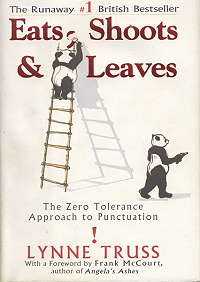
Now, after reading that, a related link caught my attention. It was about a rare case involving a comma (Merriam-Webster's: a punctuation mark, used especially as a mark of separation within the sentence -- yes, THAT comma!) which cost a giant communications company to pay another company more than US$2M. Wow. I think law schools should make Eats, Shoots & Leaves: The Zero Tolerance Approach to Punctuation (Lynne Truss) a required reading! (I'm sure Mordsith won't have a problem like this case once she's done with her study. We can earn big bucks here!)
Here-are-the-links-please-read Link #2: Comma quirk irks Rogers
GRANT ROBERTSON
From Monday's Globe and Mail
August 6, 2006 at 11:30 PM EDT
It could be the most costly piece of punctuation in Canada.
A grammatical blunder may force Rogers Communications Inc. to pay an extra $2.13-million to use utility poles in the Maritimes after the placement of a comma in a contract permitted the deal's cancellation.
The controversial comma sent lawyers and telecommunications regulators scrambling for their English textbooks in a bitter 18-month dispute that serves as an expensive reminder of the importance of punctuation.
Rogers thought it had a five-year deal with Aliant Inc. to string Rogers' cable lines across thousands of utility poles in the Maritimes for an annual fee of $9.60 per pole. But early last year, Rogers was informed that the contract was being cancelled and the rates were going up. Impossible, Rogers thought, since its contract was iron-clad until the spring of 2007 and could potentially be renewed for another five years.
Armed with the rules of grammar and punctuation, Aliant disagreed. The construction of a single sentence in the 14-page contract allowed the entire deal to be scrapped with only one-year's notice, the company argued.
Language buffs take note — Page 7 of the contract states: The agreement “shall continue in force for a period of five years from the date it is made, and thereafter for successive five year terms, unless and until terminated by one year prior notice in writing by either party.”
Rogers' intent in 2002 was to lock into a long-term deal of at least five years. But when regulators with the Canadian Radio-television and Telecommunications Commission (CRTC) parsed the wording, they reached another conclusion.
The validity of the contract and the millions of dollars at stake all came down to one point — the second comma in the sentence.
Had it not been there, the right to cancel wouldn't have applied to the first five years of the contract and Rogers would be protected from the higher rates it now faces.
“Based on the rules of punctuation,” the comma in question “allows for the termination of the [contract] at any time, without cause, upon one-year's written notice,” the regulator said.
Rogers was dumbfounded. The company said it never would have signed a contract to use roughly 91,000 utility poles that could be cancelled on such short notice. Its lawyers tried in vain to argue the intent of the deal trumped the significance of a comma. “This is clearly not what the parties intended,” Rogers said in a letter to the CRTC.
But the CRTC disagreed. And the consequences are significant.
The contract would have shielded Rogers from rate increases that will see its costs jump as high as $28.05 per pole. Instead, the company will likely end up paying about $2.13-million more than expected, based on rough calculations.
Despite the victory, Aliant won't reap the bulk of the proceeds. The poles are mostly owned by Fredericton-based utility NB Power, which contracted out the administration of the business to Aliant at the time the contract was signed.
Neither Rogers nor Aliant could be reached for comment on the ruling. In one of several letters to the CRTC, Aliant called the matter “a basic rule of punctuation,” taking a swipe at Rogers' assertion that the comma could be ignored.
“This is a classic case of where the placement of a comma has great importance,” Aliant said.
Lazy Thursday... Happy weekend. :-)
03 May 2009
The British Monarchy to Confer Knighthood to Pacquiao
Not! But hey, would you actually be surprised if Pacquiao, in addition to his honoris causas, became a knight? Hehehe. Picture this out:
Pacquiao won over Hatton in just two rounds. TKO! I didn't expect that. Honestly, I actually doubted if Pacquaio would win... at least during the first 30 seconds. I have no idea how Hatton fights and when I saw him clinging on to Pacquiao (using his left hand to cling to Pacquiao, and his right hand to punch him -- what?!?!), I thought it would irritate Pacquaio, and might cause him to lose this game. But in a few seconds after that, I was convinced: Pacquiao owns Hatton.

Had Pacquiao been alive during the 16th century, I doubt if the Spaniards would have the balls to conquer us.

I lost a bet to a friend of mine 'coz I sided with Hatton. But not because I want Hatton. Nagsigurado lang: Had Hatton won, well, I would have mourned the defeat of a Filipino athlete, but at least I won a bet (Starbucks coffee and cheesecake); but since Pacquiao won, I lost a bet but I have never been so proud of Pacquiao's victory before.
Congratulations, Manny "Pacman" Pacquaio!
Sir Manny "Pacman" Pacquaio, PhD
Pacquiao won over Hatton in just two rounds. TKO! I didn't expect that. Honestly, I actually doubted if Pacquaio would win... at least during the first 30 seconds. I have no idea how Hatton fights and when I saw him clinging on to Pacquiao (using his left hand to cling to Pacquiao, and his right hand to punch him -- what?!?!), I thought it would irritate Pacquaio, and might cause him to lose this game. But in a few seconds after that, I was convinced: Pacquiao owns Hatton.

Had Pacquiao been alive during the 16th century, I doubt if the Spaniards would have the balls to conquer us.

I lost a bet to a friend of mine 'coz I sided with Hatton. But not because I want Hatton. Nagsigurado lang: Had Hatton won, well, I would have mourned the defeat of a Filipino athlete, but at least I won a bet (Starbucks coffee and cheesecake); but since Pacquiao won, I lost a bet but I have never been so proud of Pacquiao's victory before.
Congratulations, Manny "Pacman" Pacquaio!
Subscribe to:
Posts (Atom)