I was reading a United States Supreme Court case (yeah, just one of the things I usually do when I am not hacking government databases, searching new constellations, and mapping DNAs of mutant hybrids) where the court was actually burdened with the task of deciding how much of a sentence does an adverb modify. (Isipin mo nga naman. Rico's top secret BPO company can do this ah?!) The adverb in question is "knowingly" and part of the sentence is "knowingly transfers, possesses or uses, without lawful authority, a means of identification of another person." The case? Here's a summary:
Here-are-the-links-please-read Link #1: Supreme Court decides what an adverb modifies
On May 4th, the U.S. Supreme Court decided unanimously, in Flores-Figueroa v. United States, that the word "knowingly" modifies not only the verb, but also the direct object following the verb. In doing so, the Court also decided that illegal aliens cannot be found guilty of Aggravated Identity Theft unless they know their false identification numbers actually belong to someone else. Flores-Figueroa is a Mexican citizen who pled guilty to misuse of immigration documents and entering into the U.S. without inspection. Aggravated Identity Theft provides for two years to be added to the sentence of any such person if he "knowingly transfers, possesses or uses, without lawful authority, a means of identification of another person." 18 U.S.C. §1028A(a)(1).
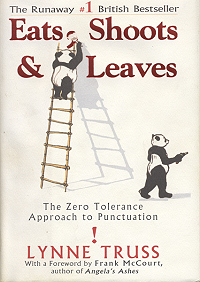
Now, after reading that, a related link caught my attention. It was about a rare case involving a comma (Merriam-Webster's: a punctuation mark, used especially as a mark of separation within the sentence -- yes, THAT comma!) which cost a giant communications company to pay another company more than US$2M. Wow. I think law schools should make Eats, Shoots & Leaves: The Zero Tolerance Approach to Punctuation (Lynne Truss) a required reading! (I'm sure Mordsith won't have a problem like this case once she's done with her study. We can earn big bucks here!)
Here-are-the-links-please-read Link #2: Comma quirk irks Rogers
GRANT ROBERTSON
From Monday's Globe and Mail
August 6, 2006 at 11:30 PM EDT
It could be the most costly piece of punctuation in Canada.
A grammatical blunder may force Rogers Communications Inc. to pay an extra $2.13-million to use utility poles in the Maritimes after the placement of a comma in a contract permitted the deal's cancellation.
The controversial comma sent lawyers and telecommunications regulators scrambling for their English textbooks in a bitter 18-month dispute that serves as an expensive reminder of the importance of punctuation.
Rogers thought it had a five-year deal with Aliant Inc. to string Rogers' cable lines across thousands of utility poles in the Maritimes for an annual fee of $9.60 per pole. But early last year, Rogers was informed that the contract was being cancelled and the rates were going up. Impossible, Rogers thought, since its contract was iron-clad until the spring of 2007 and could potentially be renewed for another five years.
Armed with the rules of grammar and punctuation, Aliant disagreed. The construction of a single sentence in the 14-page contract allowed the entire deal to be scrapped with only one-year's notice, the company argued.
Language buffs take note — Page 7 of the contract states: The agreement “shall continue in force for a period of five years from the date it is made, and thereafter for successive five year terms, unless and until terminated by one year prior notice in writing by either party.”
Rogers' intent in 2002 was to lock into a long-term deal of at least five years. But when regulators with the Canadian Radio-television and Telecommunications Commission (CRTC) parsed the wording, they reached another conclusion.
The validity of the contract and the millions of dollars at stake all came down to one point — the second comma in the sentence.
Had it not been there, the right to cancel wouldn't have applied to the first five years of the contract and Rogers would be protected from the higher rates it now faces.
“Based on the rules of punctuation,” the comma in question “allows for the termination of the [contract] at any time, without cause, upon one-year's written notice,” the regulator said.
Rogers was dumbfounded. The company said it never would have signed a contract to use roughly 91,000 utility poles that could be cancelled on such short notice. Its lawyers tried in vain to argue the intent of the deal trumped the significance of a comma. “This is clearly not what the parties intended,” Rogers said in a letter to the CRTC.
But the CRTC disagreed. And the consequences are significant.
The contract would have shielded Rogers from rate increases that will see its costs jump as high as $28.05 per pole. Instead, the company will likely end up paying about $2.13-million more than expected, based on rough calculations.
Despite the victory, Aliant won't reap the bulk of the proceeds. The poles are mostly owned by Fredericton-based utility NB Power, which contracted out the administration of the business to Aliant at the time the contract was signed.
Neither Rogers nor Aliant could be reached for comment on the ruling. In one of several letters to the CRTC, Aliant called the matter “a basic rule of punctuation,” taking a swipe at Rogers' assertion that the comma could be ignored.
“This is a classic case of where the placement of a comma has great importance,” Aliant said.
Lazy Thursday... Happy weekend. :-)
